























 0
0
For years, Europe has built its prosperity on a paradox: its agriculture depends on fertilizers it cannot produce, and manufacturing some of those fertilizers also requires natural gas whose supply it does not control. These two intertwined dependencies went largely unnoticed during times of stability until recently. The war in Ukraine was the first warning; the closure of the Strait of Hormuz in 2026 was the confirmation.
Dependence on inorganic fertilizers
The EU's annual consumption of mineral fertilizers reached 9.8 million tonnes (nitrogen and phosphorus) in 2024, and its reliance on imports is structurally critical for all three primary nutrients (N, P, and K). By April 2026, average nitrogen fertilizer prices were 71% higher than the 2024 average.

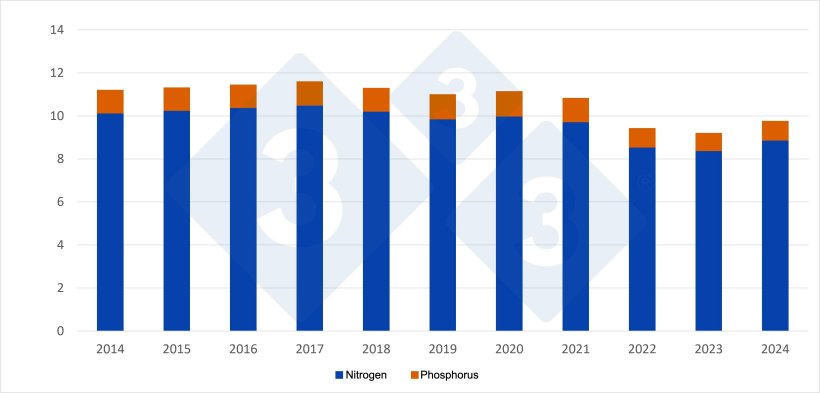
For nitrogen fertilizers, the EU imports between 30% and 40% of its consumption. The main product is urea, which is manufactured through the Haber–Bosch process and depends directly on natural gas. Since natural gas accounts for around 70% of production costs, higher prices and price volatility undermine the competitiveness of the European fertilizer industry and increase reliance on imports. The EU's main suppliers are Russia (historically one of the largest suppliers, although shipments have fluctuated due to sanctions and geopolitical tensions), Egypt (a key supplier thanks to access to low-cost natural gas), Algeria (an important supplier for southern Europe), Qatar (a major producer due to its abundant natural gas reserves), and the Gulf states (Saudi Arabia, Oman).
For phosphates, dependence reaches 70%. It is worth remembering that phosphates are a finite, limited, and non-renewable resource, derived from phosphate rock deposits. Global reserves are highly concentrated in just a few countries, particularly Morocco (including the Western Sahara), which holds the largest share of the world's phosphate reserves. Other significant countries include China, the United States, and Russia.
For potash, dependence stands at 40%. Belarus has traditionally been one of the EU's largest suppliers. Other key sources include Russia, another major player in the global potash market, and Canada, the world's largest producer, whose importance to the European market has grown following sanctions imposed on Belarus and Russia.
Energy sovereignty
But the issue extends beyond fertilizers. The EU also imports large volumes of natural gas, a key raw material not only for energy generation but also for the production of fertilizers, particularly ammonia and urea.
The Strait of Hormuz is the only maritime passage connecting the Persian Gulf to the rest of the world. Through its narrow 3-4 km-wide navigable channel passes a substantial share of the crude oil, liquefied natural gas, and fertilizers exported by countries such as Saudi Arabia, Qatar, the United Arab Emirates, and Iraq. This explains its strategic importance: in 2024, the Gulf countries accounted for approximately 43% of global seaborne urea trade and 44% of elemental sulfur trade; the latter is an essential raw material for phosphate fertilizer production. As a result, when the strait is blocked, it disrupts not one but two critical supply chains simultaneously: energy and fertilizers, two pillars of Europe's food sovereignty affected by the same event.
Although European imports from this region account for only a small share of the total (around 3% of ammonia imports and 1-2% of nitrogen fertilizer imports), the global nature of these markets means that any disruption to trade has an immediate impact on prices.
When farms enter the equation
Reducing this dual dependence could, at least in part, involve placing greater value on resources we already have but have rarely viewed as strategic: livestock manure.
Livestock manure, historically managed as a problematic waste product, is a source of both fertilizers and biogas. Through anaerobic digestion, slurry, manure, and poultry litter are converted into digestate—a nutrient-rich by-product containing nitrogen, phosphorus, and potassium—and biogas, which can be used to generate electricity, heat, or biomethane.
For livestock farms, this approach represents a paradigm shift. It is no longer simply about "managing waste," but about participating in a circular system capable of recovering nutrients, reducing dependence on imported mineral fertilizers, and generating energy within the territory. In areas with a high concentration of livestock production, particularly pig farming, the key lies not only in producing biogas but also in efficiently organizing the separation, concentration, transport, and application of nutrients where they are actually needed.
The challenge, however, is significant. For livestock manure to become part of the solution, it will require treatment plants that are adapted to on-farm conditions, cooperative models among producers, legal security, investment, nutrient traceability, and a regulatory framework that clearly distinguishes between raw manure and fertilizer products recovered through advanced treatment processes.
One of the initiatives that best reflects this change of focus is RENURE (REcovered Nitrogen from manURE). The concept refers to fertilizers obtained from the treatment of livestock manure—such as digestate, recovered ammonium sulfate, or nitrogen concentrates—that can supply nutrients in a manner comparable to mineral fertilizers. Last February, the European Commission adopted new rules on RENURE nitrogen, which are expected to help reduce farmers' dependence on imported fertilizers. Under the new rules, the use of RENURE fertilizers is allowed to exceed the limit established by the Nitrates Directive for the application of manure and processed manure.
In light of this situation, several questions arise: Can livestock manure truly become a meaningful tool for strengthening Europe's energy and fertilizer sovereignty? What technical, economic, and regulatory barriers must be overcome? And to what extent can the livestock sector become part of the solution?
In the second part of this article, we will explore these questions with Xavier Flotats, one of Europe's leading experts in anaerobic digestion, livestock manure valorization, and biogas production.